

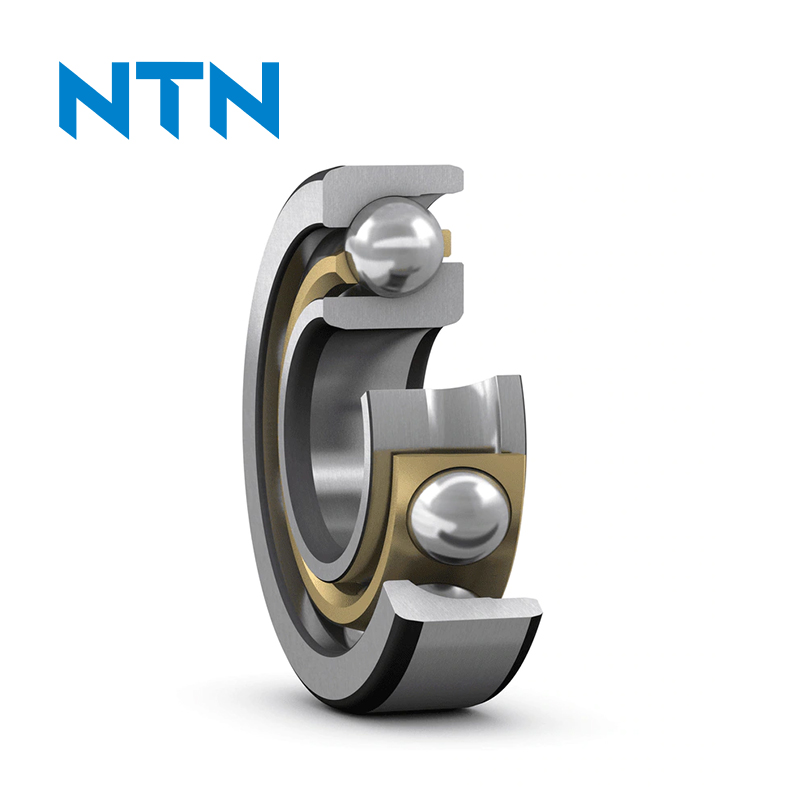
Angular contact ball bearings can simultaneously accommodate radial and axial loads. They are capable of operating at high rotational speeds. The greater the contact angle, the higher the axial load capacity. High-precision and high-speed bearings typically employ a 15-degree contact angle. Under axial force, the contact angle increases.
Single-row angular contact ball bearings can only withstand axial loads in one direction. When subjected to radial loads, they generate additional axial forces. Moreover, they can only restrict axial displacement of the shaft or housing in one direction. With a contact angle of 40 degrees, angular contact ball bearings can withstand substantial axial loads. These bearings feature a non-separable design, where the shoulders on both sides of the inner and outer rings are of unequal height. To enhance load capacity, one shoulder is machined lower, allowing for greater ball packing.
Double-row angular contact ball bearings can withstand substantial radial loads, combined radial and axial loads, and torque loads, while restricting axial displacement in both directions. Primarily employed in components restricting bidirectional axial displacement of shafts and housings. The tilt capability between inner and outer rings in double-row angular contact ball bearings is limited. The permissible tilt angle depends on the bearing's internal clearance, dimensions, internal design, and the forces and moments acting upon it. This angle must ensure no excessive additional stresses develop within the bearing. The presence of an inclination angle between the inner and outer rings adversely affects bearing service life, diminishes operational precision, and increases operational noise.
Double-row angular contact ball bearings typically employ nylon cages or solid brass cages. During installation, note that although the bearing can withstand axial loads in both directions, if one side features a ball-loading notch, care must be taken to avoid subjecting the primary axial load to the groove edge on the notched side. During operation, ensure the raceway without the ball-loading notch bears the main load.
Single-row angular contact ball bearings: Machine tool spindles, high-frequency motors, gas turbines, booster pumps, drilling rigs, food processing machinery, indexing heads, welding machines, low-noise cooling towers, electromechanical equipment, etc.
Double-row angular contact ball bearings: Oil pumps, Roots blowers, air compressors, various transmissions, fuel injection pumps, food packaging machinery, welding machines, soldering irons, square boxes, gravity-fed spray guns, inspection and analysis equipment, fine chemical machinery, etc.
“Do you see over yonder, dear client, those tricky equipment bottlenecks, those wear-and-tear troubles that stall your production? I intend to arm your machines with genuine imported bearings—and stand by with technical support to slay every glitch that comes your way.”
— Hengzhou Bearings

leave a comment