

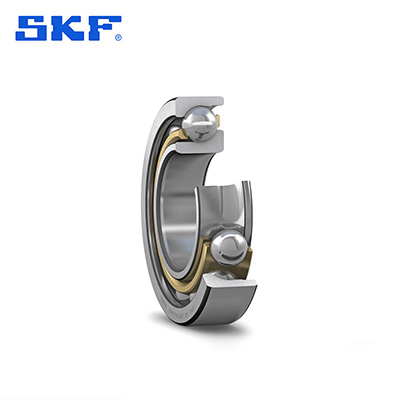
Angular contact ball bearings can simultaneously accommodate radial and axial loads. They are capable of operating at high rotational speeds. The greater the contact angle, the higher the axial load capacity. The contact angle is defined as the angle between the line connecting the contact points of the balls and raceway in the radial plane and the perpendicular line to the bearing axis. High-precision and high-speed bearings typically employ a 15-degree contact angle. Under axial force, the contact angle increases.
Single-row angular contact ball bearings can only accommodate axial loads in one direction. When subjected to radial loads, they generate additional axial forces. Furthermore, they can only restrict axial displacement of the shaft or housing in one direction. With a contact angle of 40 degrees, these bearings can withstand substantial axial loads. They feature a non-separable design, with the shoulders on both sides of the inner and outer rings being of unequal height. To enhance load capacity, one shoulder is machined lower, allowing greater ball packing.
Double-row angular contact ball bearings primarily handle substantial radial loads, combined radial-axial loads, and torque loads, restricting axial displacement in both directions. Primarily employed in components restricting bidirectional axial displacement of shafts and housings. The internal and external rings of double-row angular contact ball bearings possess limited inclination capability. The permissible inclination angle depends on the bearing's internal clearance, dimensions, internal design, and the forces and moments acting upon it. The maximum permissible inclination angle must ensure no excessive additional stresses develop within the bearing. The presence of an inclination angle between the inner and outer rings adversely affects bearing service life, diminishes operational precision, and increases operational noise. Double-row angular contact ball bearings typically employ nylon cages or solid brass cages. During installation, note that although the bearing can withstand axial loads in both directions, if one side features a ball-loading notch, care must be taken to avoid subjecting the primary axial load to the groove edge on the notched side. During operation, ensure the raceway without the ball-loading notch bears the main load.
Paired Double-Row Ball Bearings
When installing as a paired unit, position the outer rings of the pair facing each other, i.e., wide faces to wide faces and narrow faces to narrow faces. This arrangement prevents additional axial forces and confines the shaft or housing within axial clearance limits in both directions.
As the raceways of the inner and outer rings can undergo relative displacement along a horizontal axis, these bearings can simultaneously accommodate both radial and axial loads—combined loads (single-row angular contact ball bearings can only handle axial loads in one direction, hence paired installation is commonly employed).
Cage materials include brass and synthetic resin, selected according to bearing type and operating conditions.
With one narrow edge facing outwards and one wide edge facing inwards, while the other wide edge faces inwards and narrow edge outwards, this configuration constitutes back-to-back contact.
“Do you see over yonder, dear client, those tricky equipment bottlenecks, those wear-and-tear troubles that stall your production? I intend to arm your machines with genuine imported bearings—and stand by with technical support to slay every glitch that comes your way.”
— Hengzhou Bearings

leave a comment