

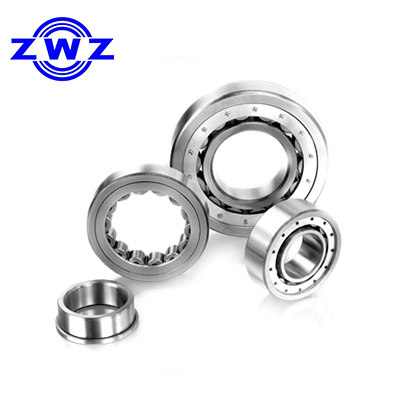
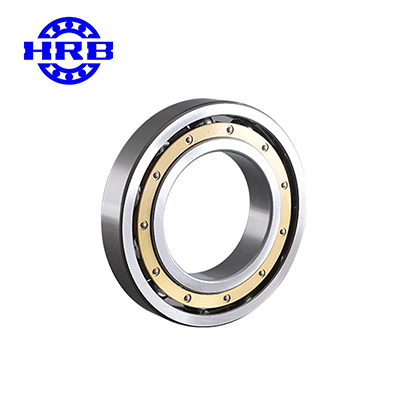
The rolling elements exhibit low friction against the flanges of the rings, making them suitable for high-speed rotation. Based on whether the rings have flanges, these bearings can be classified into single-row cylindrical roller bearings such as NU, NJ, NUP, N, and NF, and double-row cylindrical roller bearings such as NNU and NN. This bearing features a separable inner and outer ring structure. Cylindrical roller bearings without flanges on either the inner or outer ring allow axial relative movement between the rings, enabling their use as non-locating bearings. Bearings with double flanges on one side and a single flange on the opposite side can withstand axial loads in one direction to a certain extent. Typically, stamped steel cages or solid copper alloy cages are used. However, some applications employ molded polyamide cages.
Characteristics of Cylindrical Roller Bearings: Rollers and raceways engage in line contact or modified line contact, providing high radial load capacity suitable for heavy and impact loads. Low friction coefficient enables high-speed operation, with maximum rotational speeds approaching those of deep groove ball bearings. N and NU types permit axial movement, accommodating shaft-to-housing positional changes due to thermal expansion or installation errors, making them suitable for free-end supports. High machining precision is required for shafts or housing bores. After installation, relative misalignment of the outer ring axis must be strictly controlled to prevent contact stress concentration. The inner or outer ring can be separated, facilitating installation and disassembly.
Cylindrical rollers and raceways engage in line contact, providing high radial load capacity. They are suitable for heavy loads, impact loads, and high-speed rotation. The raceways and rolling elements of cylindrical roller bearings feature a geometric shape. Through design improvements, they achieve high load capacity. The novel structural design of the flanges and roller end faces not only enhances the bearing's axial load capacity but also improves lubrication conditions in the contact area between the roller end faces and flanges, thereby boosting bearing performance.
Primarily used in large and medium-sized electric motors, locomotives and rolling stock, machine tool spindles, internal combustion engines, generators, gas turbines, gearboxes, rolling mills, vibrating screens, and lifting and transport machinery.
“Do you see over yonder, dear client, those tricky equipment bottlenecks, those wear-and-tear troubles that stall your production? I intend to arm your machines with genuine imported bearings—and stand by with technical support to slay every glitch that comes your way.”
— Hengzhou Bearings

leave a comment