

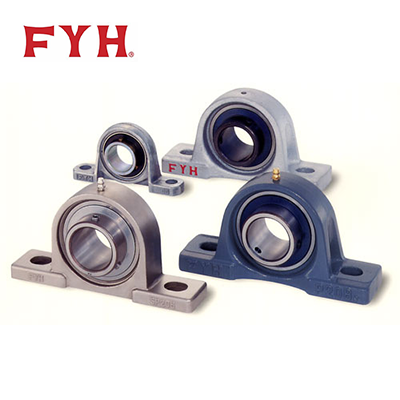
Spherical outer ring ball bearings are essentially a variant of deep groove ball bearings, characterized by a spherical outer diameter surface on the outer ring. This allows the bearing to fit into a corresponding concave spherical surface in the bearing housing, enabling self-alignment.
Although their fundamental performance should be similar to deep groove ball bearings, these bearings are often used in relatively rough machinery. Installation positioning is not precise, shaft-to-housing alignment is poor, or shafts are long with significant deflection. Furthermore, the bearings themselves lack high precision, and some designs are relatively crude. Consequently, their actual performance is significantly reduced compared to deep groove ball bearings of the same specifications.
Outer spherical ball bearings with an eccentric sleeve have essentially the same performance as those with a set screw, except the set screw is located on the eccentric sleeve rather than the inner ring. Outer spherical ball bearings with tapered bores feature a 1:12 tapered bore. They can be directly mounted on tapered shafts or installed on smooth shafts without shoulders using a locking sleeve, allowing for fine adjustment of bearing clearance.
Spherical outer ring bearings are primarily suited for applications requiring simple equipment and components, such as agricultural machinery, transportation systems, or construction equipment. They are mainly used to withstand combined radial and axial loads where radial loads predominate. Generally, they should not bear axial loads alone. Both the inner and outer rings of this bearing type can be mounted separately. These bearings do not permit shaft misalignment relative to the housing and generate additional axial forces under radial load conditions. The magnitude of axial clearance significantly impacts bearing functionality. Insufficient axial clearance leads to elevated temperature rise, while excessive clearance increases susceptibility to bearing damage. Therefore, meticulous adjustment of axial clearance during installation and operation is essential. When necessary, preload installation may be employed to enhance bearing rigidity.
“Do you see over yonder, dear client, those tricky equipment bottlenecks, those wear-and-tear troubles that stall your production? I intend to arm your machines with genuine imported bearings—and stand by with technical support to slay every glitch that comes your way.”
— Hengzhou Bearings

leave a comment